Showing posts with label Google. Show all posts

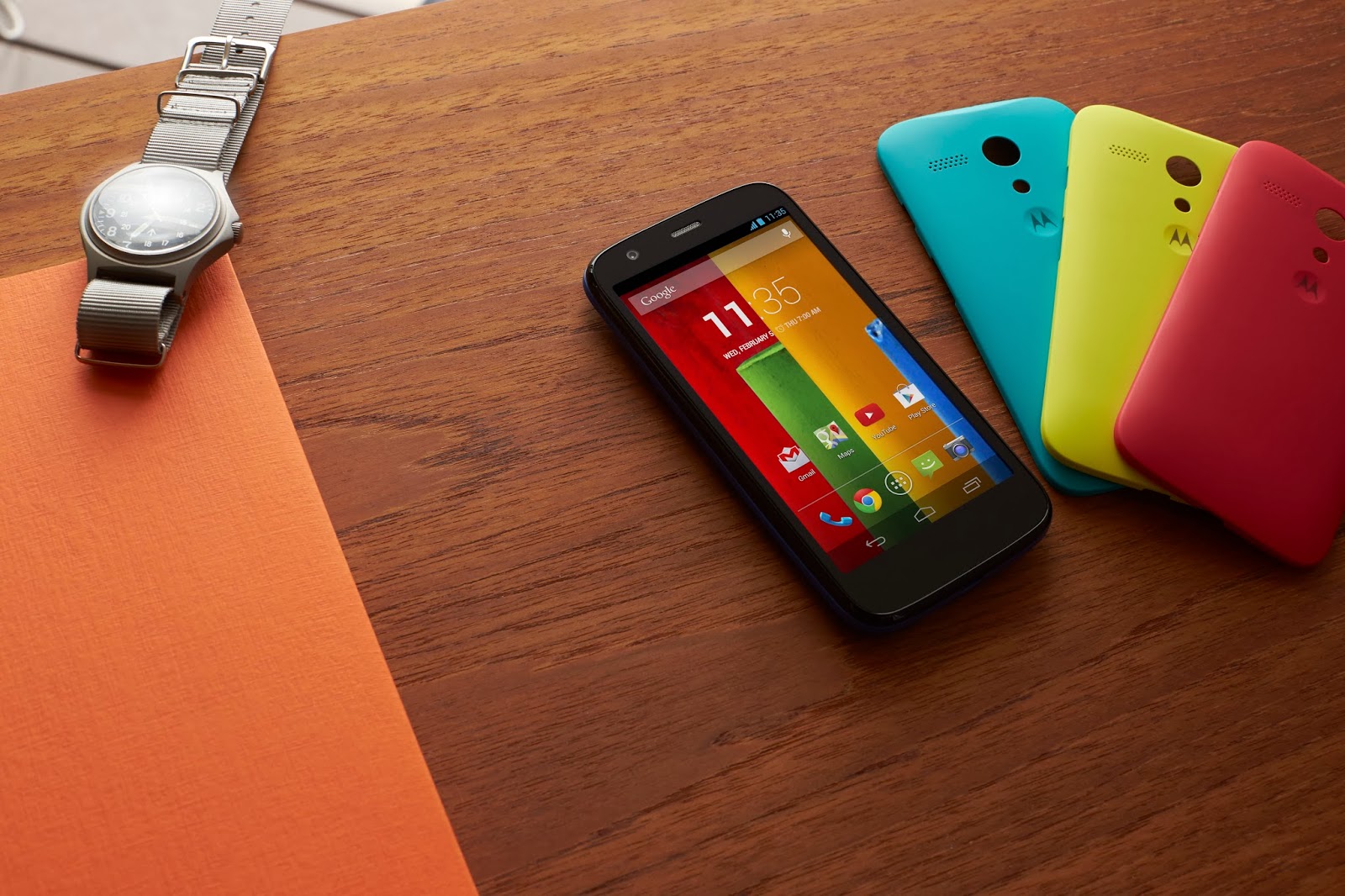
Moto G review


You're not getting the best or the latest technology with Motorola's $179 Moto G smartphone. What you do get is a great price for something close.
Motorola bills the Moto G as the phone for the rest of us - the ones who can't afford $500 to $700 for a high-end smartphone. That's a big deal overseas, where carriers don't subsidize phones with two-year service contracts the way they do in the United States. But even in the U.S., more people are moving to contract-free plans and ones that offer frequent upgrades, meaning the full retail price is what's going to matter.
The Moto G started shipping in the U.S. this week, initially for the GSM networks used by AT&T and T-Mobile. I spent the past week testing the Moto G, comparing the phone primarily with its more expensive cousin, Motorola's $500 Moto X. I also put it up against another lower-cost phone, Google's $349 Nexus 5, as well as the premium, $649 iPhone 5s from Apple.
Where the Moto G fell short was in its camera, battery life and inability to access faster, 4G LTE cellular networks. For everything else I tested, the Moto G stood up well.
Motorola, which is owned by Google Inc., doesn't skimp in equipping the Moto G with a speedy processor. Apps launch almost as quickly as they do on the phone's pricier rivals. The Moto G runs a fairly recent version of Google's Android system, with a promised upgrade to the latest, Kit Kat, early next year.
The Moto G also has a decent screen. It's about as sharp as the Moto X's and the iPhone's, enough for 720p video, though the Nexus and various Samsung phones do better by offering full, 1080p high definition. The Moto G's screen measures 4.5 inches (11.4 centimeters) diagonally, which is larger than the iPhone's but small for Android. Colors aren't as rich as on the Moto X's display, but if I want a superb visual experience, I'd turn to a tablet, a TV or even a movie theater. For a phone, the Moto G's screen delivers video quite well.
The Moto G doesn't win points on size and weight. Although the screen is smaller than the Moto X's 4.7-inch (11.9-centimeter) display, the phone overall is a tad bulkier and 10 percent heavier. The Moto G has a larger frame surrounding the screen - something phone makers have been trying to shrink.

Cellular Access


The Moto G delivers 3G performance at best. Many parts of the world are moving to 4G, but Motorola points out that many of its target markets are still upgrading to 3G. Even in the U.S., many regions lack 4G. If I'm doing a lot of things requiring top-notch speeds, I'm better off finding a Wi-Fi network anyway.

Battery Life


The Moto G has 6 percent less battery capacity than the Moto X. I got about up to eight hours of streaming video on Hulu with the Moto G, compared with nine to 10 hours on the Moto X. Although the Moto G has a removable plastic back, the battery can't be exchanged with a spare. That said, eight hours for streaming video is a lot, and you can stretch it to a full day with more moderate use.

Camera

The main camera has a resolution of 5 megapixels, less than the 8 megapixels on the iPhone and the Nexus and the 10 megapixels on the Moto X. There's more to a good camera than the pixel count, but the pictures I took with the Moto G weren't particularly good, especially in low light. They are passable for selfies and Facebook posts, but you'll want a better camera for keepsakes. Perhaps the money you save on the phone can go to a point-and-shoot camera that takes better pictures.
The Moto G is also short on frills. Part of that stems from Motorola's philosophy not to tinker with the Android operating system too much. Many rival phone makers do just that and wind up creating more chaos and confusion.
Instead, Motorola tries to limit what it adds. In the case of the Moto X, you can twist the phone to automatically launch the camera. You can initiate voice commands by saying, "OK, Google Now." The Moto X also offers unprecedented customization when you order; you can choose everything from the color of the power button to a personalized message on the back cover.
The Moto G has none of that. The frills are limited to an FM radio tuner, something rare in smartphones. Just plug in a pair of headphones, which serves as the antenna. You can swap the back with a new plastic cover, but the phone isn't assembled at the factory to your specifications.
Be aware that the $179 price gets you 8 gigabytes of storage, half of what most phones offer. Given all the room your photos and video will need, pay the extra $20 for a 16 gigabyte model. Unfortunately, there's no slot for memory cards, as some Android phones offer.
Motorola sells the phone unlocked, meaning you can switch carriers as long as they use GSM. Verizon and Sprint are among the few carriers in the world using a different technology, CDMA. A Verizon version is coming early next year, while Sprint won't say whether it will have one.
Phone makers have been trying to set themselves apart by loading phones with more and more features, only some of which are useful. Motorola doesn't try to do that with the Moto G, apart from including an FM tuner. Instead, it's distinguishing itself through price. No one can question whether that's useful.
Top 10 Gadgets of 2013

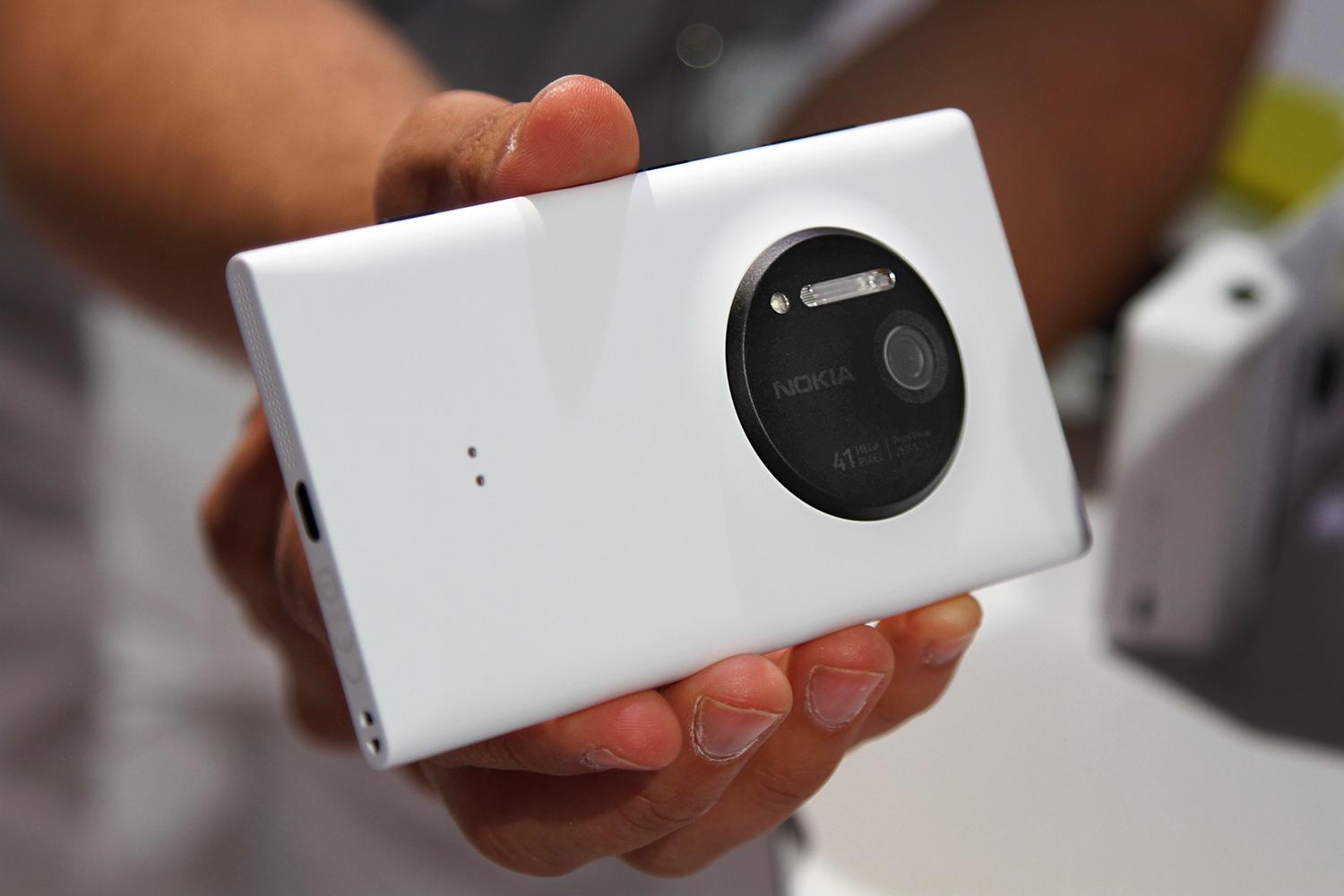
10. Nokia Lumia 1020

Harry McCracken / TIME

Every modern wireless phone is a cameraphone, but this Lumia is something new: a phonecamera. Its oversized sensor packs 41 megapixels of resolution; you can capture the most detailed phone snapshots you’ve ever seen, and zoom in without reducing your pictures to a blocky mess. (You have to download the high-res versions to a computer via USB cable, but it’s worth the effort.) Even iPhone and Android fans who thought they couldn’t care less about Windows Phones might find themselves smitten with this one.

9. Leap Motion Controller

Leap Motion

This pint-sized USB accessory for Windows PCs and Macs is an $80 preview of where man-machine interfaces may be headed. Plug it in, plop it on a flat surface, and you can perform tasks — from playing games to reading New York Times stories — by waving your hands in the air. It can even detect the angle your palms and how many fingers you’re sticking out. The technology is also being built into laptops, starting with HP’s Envy17 Leap Motion SE.

8. Nest Protect

Nest Labs

Silicon Valley startup Nest Labs specializes in making the most mundane household devices a lot less mundane. In 2012, it introduced a Web-savvy touch-screen thermostat. And its new product is Nest Protect, a $130 smoke and carbon-monoxide detector. Rather than emitting an eardrum-shattering squeal, Protect alerts you to hazards in a calm female voice which says helpful things like “There’s carbon monoxide in the den.” If it mistakes your smokey cooking for a fire, you can set it wise with a wave of your arm.

7. Amazon Kindle Fire HDX

Amazon

Amazon’s third-generation Kindle Fire tablets — a $239 seven-inch model and a $379 8.9-incher — are the first ones which felt truly polished and pleasing from the day they debuted. As always, they make it as simple as possible to consume mass quantities of Amazon content — video, music, books, games and more. And they’ve got one feature that’s a ground-breaking dazzler: Mayday, which lets you get tech support from a real live Amazon rep who appears on screen and can take control of your tablet.

6. Microsoft Xbox One


Officially, Microsoft’s Xbox One is a game console, but its aspirations go far beyond play. With built-in video calls via Skype, integration with cable and satellite TV boxes and an interface derived from Windows 8, it’s really a living-room PC. The most intriguing technology is built into the new Kinect sensor, which understands spoken commands, recognizes faces and can even measure your heart rate. Some aspects of the One are still rough around the edges, but it’s going to be fascinating to see where it goes.

5. Apple iPhone 5s


iPhones with an “s” at the end of their model numbers are supposedly snoozers, because they focus on refinements to the previous year’s model. But the iPhone 5s introduces two of the best smartphone features which Apple or anyone else has ever come up with. The Touch ID sensor lets unlock your phone with a quick press of your finger or thumb. And the camera sports a unique dual-LED flash which provides subtle, custom lighting for an array of picture-taking scenarios.

4. Pebble Smartwatch

Pebble

Whether smartwatches ever turn into a booming business to rival smartphones or tablets remains anyone’s guess. But Pebble is off to a promising start. The $150 wearable gizmo acts as a satellite for your iPhone or Android handset, receiving snippets such as text-message notifications via Bluetooth and displaying them on its power-efficient E Ink display. Third-party developers can write programs to let it do everything from playing games to tracking your fitness. Did we mention that it tells time?

3. Oculus Rift Development Kit

Virtuix Omni / YouTube

At the moment, Oculus Rift is only available in a $300 kit aimed at game developers. But once you strap on this virtual-reality headset onto your noggin and experience it in action, you’ll get itchy for the consumer release, which is scheduled for 2014. Used with a PC or Android device, Rift will let games create 3D worlds which surround you — you can even look over your shoulder for enemies lurking behind. If the games live up to the hardware’s potential, it could be an epoch-shifting landmark.

2. Apple’s new iPads

Apple

Do you want a powerful iPad or a portable one? How about both? At just one pound and .29-inch thick, the 9.7-inch iPad Air is much svelter than previous full-sized models. And except for the smaller screen, the 7.9-inch iPad Mini with Retina has almost exactly the same potent components as its big brother, as well as the same ten-hour battery life. Both benefit hugely from the App Store’s 475,000 iPad-optimized apps. It’s best tablet you can buy, in two convenient sizes.

1. Google Chromecast


Instead of trying to do everything — like Google’s famously ambitious and unsuccessful Google TV — this thumb-sized gizmo does one thing, does it as simply as possible and does it for the impulse-purchase price of $35. Plug it into one of your TV’s HDMI ports, and you can fling videos and other content from your laptop, tablet or phone to the big screen, no wires involved. Lots of companies have built devices to do this; Chromecast is the first one that gets it right.


Top 10 Smartphones of 2013 (1-5)

1: Apple iPhone 5s

1iPhone5
(Image: Apple)

The iPhone 5s has the same form factor as the iPhone 5, with an improved 64-bit A7 processor and the addition of a fingerprint-enabled Touch ID central home button that makes it convenient to unlock and purchase apps from the App Store.
The iPhone camera is one of the most popular cameras in use today and the iPhone 5s sees an updated camera appear to make the experience even better.
iOS 7 launched with the iPhone 5s and I am a fan of the control center, updated notifications, improved Siri integration, and multitasking reminiscent of webOS.
The iPhone 5s feels expensive in the hand, and it is, but the fact that most new apps and services first launch on iOS is a major reason I purchased one and selected it as my top smartphone. Thanks to Apple's strict control over the hardware, developers are able to roll out apps knowing they will perform consistently.
Prices range from $199 to $399 on contract or $649 to $849 with no contract. The iPhone 5s is available on all major carriers.

Number 2: HTC One

htc-one-small
(Image: HTC)
I have been using an HTC One for about nine months and still think it is the best smartphone I have ever used.
So why didn't I give it the number one spot? The camera is fine for many situations, but there is very little "depth" in photos so details you find from other 8 megapixel or greater phone cameras are not there. If the camera is fine for you, then the HTC One may be the device to consider with fantastic hardware, Android 4.3 and the promise that 4.4 is coming, and a premium piece of hardware.
The HTC One hardware is fantastic and unmatched by any other smartphone, in my opinion. The metal body feels great in your hand and looks incredible. HTC's Super LCD displays have led the industry over the past year and manufacturers are still trying to match their awesome 1080p 4.7 inch Super LCD 3. It is powered by a quad-core 1.7 GHz processor and 2GB of RAM. While there is no microSD slot, there are internal memory options of 32GB and 64GB so that should be plenty for most people. You will also find dual mics, front facing stereo speakers, an ultra pixel camera with optical image stabilization (OIS).
In addition to top class hardware, HTC continues to offer a great user experience with Sense 5 updates and 5.5 coming soon.
You can buy the HTC One for as low as $50 subsidized on most carriers or $550 full price with no contract.

3: Samsung Galaxy Note 3

2GalaxyNote3
(Image: Samsung)
Samsung throws everything, but the kitchen sink, in the Galaxy Note 3 and I found the experience both rewarding and frustrating.
The hardware is better than the Note II and the software is optimized for the S Pen experience. Samsung softened TouchWiz and I enjoyed using many of the additional value-added services and apps provided by Samsung.
The Galaxy Note 3 has it all and is the most powerful and capable Android device available today. You will find a 1.6 GHz quad-core Samsung Exynos processor, a whopping 3GB of RAM, 5.7-inch Super AMOLED HD display, 13 megapixel rear camera, 1.9 megapixel front-facing camera, 16GB internal memory with microSD storage for up to 64GB more storage, huge 3,200 mAh removable battery so you can go a long time without charging, Bluetooth 4.0, LTE, NFC, and more.
You can find the Galaxy Note 3 on all major US wireless carriers and it is definitely a device to consider, especially for the road warrior who wants the ability to swap batteries and expand storage capacity on the go.
The Note 3 is priced at $299.99 on contract from most carriers with a full price of $699.99 without a contract.

4: Nokia Lumia 1020

Lumia1020Yellow
(Image: Nokia)
Recently Nokia revealed Their Nokia Lumia 1020.  Windows Phone continues to slowly gain market share and the best device they have at the moment is the Nokia Lumia 1020. The 1520 is coming before Thanksgiving and offers a larger display, faster processor, and lower resolution camera.
The Lumia 1020 is the phone to purchase if taking photos is one of your primary uses for your smartphone. Most top apps are available for Windows Phone, but there are still limitations on connectivity to accessories such as smartwatches and life activity trackers.
Nokia provides a number of services and apps on their Lumia devices. These include HERE Maps turn-by-turn voice navigation, Nokia Music+, advanced camera lenses and camera software, and many other Nokia exclusive apps.
Unfortunately, you can still only purchase the Lumia 1020, and soon the 1520, from AT&T in the US. The 1020 is now available for $199.99 with a 2-year contract. There are good alternative Lumias on other carriers (928, 925, etc.), but Nokia hasn't yet launched one device across all the major US carriers.

5: Google Nexus 5


5Nexus5
(Image: Google)

At the fifth position we have Google Nexus 5.  Google recently released the Nexus 5 with the latest version of Android, 4.4 KitKat. The devices is sold out on the Play Store with backlogs of 3-4 weeks so you better order now if you want one before Christmas.
The Nexus 5 has the latest and greatest internal specifications, including a Snapdragon 800 processor, 2GB RAM, 8 megapixel camera with optical image stabilization, Qi wireless charging, and more.
The Nexus 5 is the first device with Android 4.4 and it is a solid Android update. It's not perfect, but it offers an enjoyable user experience.
The price of the Nexus 5 is fantastic, if you compare apples-to-apples. However, in the US most people buy their phones with a subsidy so the real value may not be realized as the Nexus 5 is priced nearly the same as the latest and greatest smartphones. $349 (16GB) and $399 (32GB) are amazing SIM-unlocked prices that are $200 to more than $300 less than other Android and iOS devices.

read the second part of this post here


source : www.zdnet.com

Top Upcoming Phones 2014 Part-II

iPhone 6 


Apple has just launched two amazing iPhones – iPhone 5S and iPhone 5C. They were launched in September 2013. Apple iPhone 5S sold out in India in less than 24 hours even with RCOM’s scheme. There was already lots of speculations on successor of iPhone 5. Which iPhone is going to be launched by Apple iPhone 5S or iPhone 6. iPhone 5S won the battle first. So, now everyone is waiting for Apple’s upcoming phone which is iPhone 6. Storage options are said to be same.


Rumored Specifications of iPhone 6 are -

  • iOS 8
  • No Home Button
  • 13MP Camera
  • 4.9 inch display

LG G Flex


The phone was expecting to release in November. But seems like that postponed. Curved screen displays are the future of smartphones. LG in October, released this news that G-Flex will be an upcoming phone of 2014. Every one is just curious about this new design. Rumors that LG has also passed flexible OLED display patents. What else will change with this new design is the story all about!. We can see this smartphone before New Year. But these all are rumors, nothing is authentic yet about the launch of Lg G Flex. According to the latest news LG G Flex has self healing capabilities. In a recent experiment, the back panel of G flex was scratched by a knife, and within minutes it healed itself, no matter some slight scars were also present. The price of Lg G Flex is going to be around Rs. 59,000. However, G flex was released in October, but still many countries are waiting for its availability.

Rumored Specifications of LG G Flex are - 


  • 6-inch screen display, 720×1280 pixels.
  • 2.26 GHz processor.Android 4.2.2
  • 13MP camera, 2.1 MP front facing Camera.
  • 2 GB RAM.
  • Battery capacity – 3500mAH

HTC M8 

HTC is going to launch its new flagship with the codename M8. HTC M8 going to come with slim wraparound metallic body. M8 is an upcoming smartphone of HTC in 2014. HTC M8 is coming with latest android version Kitkat 4.4.

Rumored Specifications of HTC M8 are -


  • 5-inch screen display, 2K resolution of 2048 × 1080 pixels.
  • 2.2 GHz 800 Qualcomm Snapdragon processor.
  • Windows 8/Android 4.4 Kitkat.
  • 3 GB RAM.
  • Powerful camera that even take 3D snapshots.

HTC Butterfly 2

Here comes HTC Butterfly an upcoming phone of 2014 smartphone series. Ultra pixel camera, super sound sterio speakers are some of the stunning features equipped in it. Qualcomm’s Snapdragon 800 processor. 5.2 inch full HD display. Said to be waterproof smartphone. HTC Butterfly 2 promises big display and new colors. HTC Butterfly display leak was revealed by ctechcn, a chinese source. This is an upcoming phone in 2014 and successor of HTC One.

Rumoured Specifications :-


  • 5.2-inch 1080p display
  • Quad core Snapdragon 800 processor.
  • UltraPixel camera and BoomSound front-facing stereo speakers.

Merrified Smartphone by Intel

Intel has recently revealed its upcoming smartphone that will work under merrified processor. It promises integrated sensor hub. The smartphone promises in reduction in consumption of power through an entirely new atom architecture. A 4 inch display is in the news. So, what else can we expect from Intel’s bucket? well, yet to know!


So these were some of upcoming phones coming in 2014. Some smartphones are coming with android’s latest version Kitkat 4.4 in the year 2014 and some are with their in-house processors. Plan your budget for the year 2014. Whether you are Samsung lover or Apple or Nokia, every gadget company is making something really good for you with new innovations and ideas.


Blackberry Q30


Qwerty keypads once again! Those who were waiting for any new blackberry’s model can now expect their smartphone to come. Blackberry Q30 is said to release in latter part of 2014 year. Easy to type in keyboard. Fast in speed, good performance are some of the obvious features of Blackberry Q30. It is expected to arrive in second quarter of 2014.

Rumored Specifications of Blackberry Q30 are -


  • 2.3GHz processor.
  • 3 GB RAM.
  • Runs on latest Blackberry’s OS.
  • 4-inch touchscreen.

2014 year of SMART PHONES


We all are waiting for those top upcoming phones that will show their presence in the year 2014. These are going to launch in New Year –  2014 may be in the beginning or in latter half. Many other smartphones are already in the queue for current year and some have just launched successfully. There is always an excitement to have a glance on future technologies. Companies are competing for bend, curved and flexible screen displays. LG, Samsung and Apple have already showed their patent images on the web. They have created a high buzz indeed. Smartphones, tablets are now going to come with latest android version which is Android Kitkat 4.4. People are so much busy in upgrading their smartphones to latest android version which is Android 4.4 Kitkat. An update for Samsung Galaxy Note 2 has been announced and every one is upgrading their devices.

So, let’s welcome these smartphones that are going to launch on New Year! We hope that these smartphones will launch in the month of January 2014. Let’s see what happens! What do you expect from these upcoming smartphones of 2014? Some smartphones are coming with latest processor, in-house chipsets, some are with latest android version – these are some new year’s technologies. Every company has planned something really big for the year 2014! They are going to reveal these phones in 2014 with a full fledged new technologies.

Top 10 infamous Google Products

via:www.vapresspass.com

It seems as Google launches new products every once in a while.
And these new products tend to fit into two distinct categories:
  • Incredibly useful
  • Incredibly bizarre
Here is a list of top 10 infamous Products by Google
  1. Google Takeout – No, this is not Google’s food delivery service (although that’d be handy), this is a tool which allows you to download an archive of your data from things like your +1′s, Google+ Circles, Contacts and Picasa Web albums.
  2. Google Mars – While you’re probably familiar with Google Earth, Google Mars is a little less well known. However, what it lacks in notoriety it makes up for in in geeky coolness. It gives you the ability to check out spacecraft landing locations, crater depth and even comes with an infrared option.
  3. Google Health – This is one of the (many) products Google launched that didn’t quite capture the imagination of the public as anticipated. It was designed to be a portal for all of your health and wellness information. This service officially shuts down on January 1, 2013.
  4. Google SketchUp – Now, this definitely falls into the ‘incredibly useful’ category of Google products. Google SketchUp allows you to create anything in 3D from coffee pots to skyscrapers. Check out the community gallery for added inspiration.
  5. Google Correlate – If you’ve been watching the new TV show starring Kiefer Sutherland called Touch you’ll appreciate this one as it allows you to find patterns within data samples. Oooh yeah, go get your geek on!
  6. Google Sites – It’s surprising Google hasn’t done more with this in light of the self-publishing explosion of the last few years. If and when you do need a spot online to share content with a specific group, this is a decent option.
  7. Google HotPot – With SO MANY food review and recommendation services in existence, this seems like an odd one to add to the Google bucket list. And although it sits pretty seamlessly on top of Google Places. But I don’t know anyone who uses it, do you?
  8. What Do You Love? (from Google) – You may have heard about this one when it was launched a little while back but if you haven’t, it is worth putting on your ‘to-do’ list. On the back of the ‘interest graph’ explosion, this aggregates content relating to specified topics from across the Google product network.
  9. YouTube Feather – A slight cheat here as we’re looking at a sub-product from the Google-owned YouTube product. While it was released in 2009, it’s still being trialed and this means you may not have come across it yet. In short, YouTube Feather is a ‘light’ version of YouTube that aims to take the strain away from your browser and internet connection.
  10. Panoramio – A photo sharing community that invites people to share their pictures of the world mashed up over the Google maps tool.

Fortunately, most of these products are free so we’re really not in a position to complain! After some lengthy research, I was surprised by how many tools Google has either developed or acquired over the years.
So much so, that I thought it was a good idea to compile a list of the secrets of the Google product empire. Here they are, in no particular order…
So, how many of those did you know about? If you knew about all ten you either work for Google or perhaps Wikipedia!

AWESOME GOOGLE PROJECTS PART-III

Brain chips


Memory loss (amnesia) is unusual forgetfulness. You may not be able to remember new events, recall one or more memories of the past, or both. But Google  is on a project developing brain chips. They have been working on developing a brain chip that will allow you to go back into your memory and remember things you thought you forgot. Also this brain chip will help handicapped people with simple tasks like moving their wheelchairs and other things that are difficult.

Singularity Point

via http://freshadda.com/
Engineers at Google are working together to help humans reach the singularity point, which will literally make us immortal. This project will require the most intricate computer system to date. Just because it may seem impossible doesn't mean Google doesn't want to try it, they have engineers already attempting to build this incredible computer.


Google Glass


Google Glass is research and development project by Google. Google Glass displays information in a smartphone like format hands free, can interact with the Internet via natural language voice commands, and uses Google's Android operating system. While the frames do not currently have lenses fitted to them, Google is considering partnering with sunglass retailers such as Ray-Ban or Warby Parker, and may also open retail stores to allow customers to try on the device.


Motorola Future Plans


We're all chomping at the bit to see what Motorola -- which has been largely silent since being purchased by Google, finishing up its decidedly "not wow" product lines -- will bring to the table in 2013. Today, Motorola got a ringing endorsement from Google CEO Larry Page.

"In today's multiscreen world, the opportunities are endless," Page said during Thursday's first-quarter earnings call. Specifically, Page mentioned a couple features.

Battery life and durability were the focus of Page's praise. He didn't specifically mention features in any upcoming devices, but spoke more broadly. Still, it doesn't require to huge leap to figure that that power and survivability are concerns for any smartphone manufacturer -- and particularly with Motorola, which has become the gold standard in battery life with its RAZR MAXX line, and those phones didn't exactly have glass jaws, either.

Said Page:

"Think about your device. Battery life is a challenge for most people. You shouldn't need to carry around a charger to make it through the day. If your kid spills their drink on your tablet, the screen shouldn't die. And when you drop your phone, it shouldn't shatter."

"Having just seen Motorola's upcoming products myself, I'm real excited about the potential there. In just under a year, they have accomplished a lot, and have impressive velocity and execution."

That follows up talk this week about Motorola taking a "Better is better" strategy in a world where the shotgun approach -- spraying phones all over the place, basically -- has taken over.

No hints yet, either, if we'll see anything new from Motorola next month at the Google I/O developer conference.

Awesome Google projects Part-II

Clean Energy


Developing renewable energy sources such as wind, solar, and geothermal power is one of the main goals of Google's nonprofit arm, Google.org. The project concentrates on solar-powered turbine engines to create electricity, as well as on low-cost heliostats, which are mirrors that track the sun and concentrate solar energy. Google also supports efforts to map the world's potential geothermal energy sources. The goal is to create renewable sources that are cheaper than burning coal, which currently generates most of the power in the United States.

New Drugs


Google is interested in investing in new ways to fight disease. Its investment portfolio includes a stake in Adimab, which uses a novel approach involving yeast cells to speed up the discovery of new antibodies. Another Google company, iPierian, uses a technique called "cellular reprogramming" to create new drugs that attack diseases by modifying them.

Climate Change Insurance

A number of Google's investments in companies through its Google Ventures wing also have an eye toward the future. One of the companies in the portfolio is The Climate Corporation, which sells weather insurance for farmers to protect their businesses from increasingly unpredictable conditions and extreme weather.

Smart Thermostats


A Google future seems to involve making everything smarter, from drugs to cars and even home thermostats. This idea is one of the driving forces behind NEST, the sci-fi climate-control system that learns the best way to keep your home comfortable--while also saving on energy bills. NEST has already rolled out to some customers, and a waiting list has formed for the next batch.

Cancer Treatment

Fighting cancer fits perfectly with the do-good theme present in many of Google's investments. Google Ventures put some money into Foundation Medicine, which combines genomic and molecular data to create a new approach to cancer care. Perhaps curing cancer is just another engineering problem.

Predicting the Future

Google is so committed to the future, it should come as no surprise that the company is even interested in predicting it. Another Google investment is in Recorded Future, a company that seeks to parse the universe of information available online for clues about what's to come.

Awesome Google projects Part-I

Home Automation


For years we've been hearing about a refrigerator that orders milk for you when you're running low, but Google wants to expand the idea to the entire home. Its Android @Home platform already has connected light bulbs, coffee pots, and more in the works. On top of that, Google has its eye on moving beyond the home, to a much broader "Internet of Things." At the company's most recent developer conference, it rolled out its open accessory development kit for Android, inviting makers everywhere to get busy connecting anything from small gadgets to big machines.

Robots


Google is reportedly running a secret division dubbed "Google X," which includes a lab in an undisclosed location where robots rule the roost, according to the New York Times. There's no evidence of an army of T-1000s being built somewhere underground in Silicon Valley, however. Apparently Google is trying to build bots to perform all sorts of mundane tasks around the home and office (such as making coffee or copies), which will give humans greater flexibility to work remotely and focus on higher-level duties.

Driver-less Cars


At Google, cars aren't just a means of transportation--they're also an engineering problem to be solved with piles of data and cash. It just makes sense that the company that provides directions and street-level data for all locations should make the cars to take you to them as well. The New York Times reports that part of Google's plan could be to show passengers location-based ads for the businesses the self-driving cars whiz past.

Elevators to Space


Believe it or not, Google is just one of a number of organizations and individuals interested in setting up the infrastructure to leave Earth's atmosphere without the use of rocket propulsion. Space elevators are reportedly another project on the Google X agenda (see previous slide). The idea is to run a ribbon from Earth to a counterweight in orbit that allows easy access to space for all kinds of scientific experimentation and other ventures. Many people believe that we could have such lifts operational in less than a decade.